7 min read
Journal · Places & Heritage
Exploring Chittorgarh Fort: The Legend of Bravery, Siege Warfare, and Architectural Genius
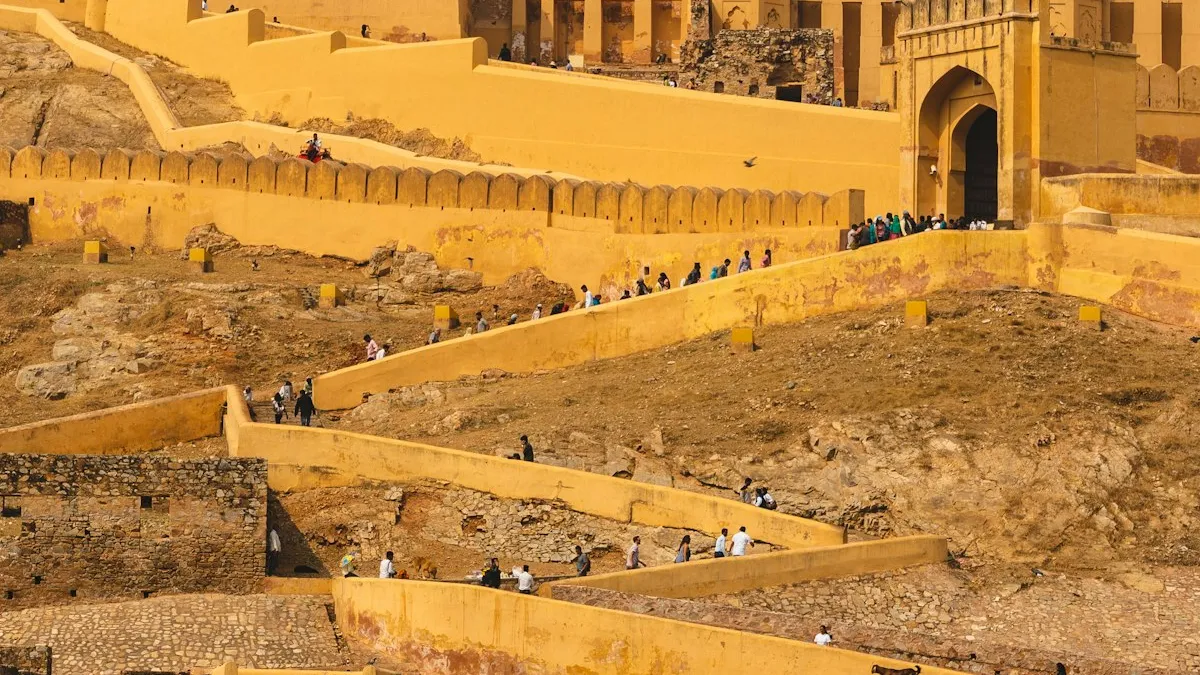
Perched 180 meters above the Mewar plains across 700 acres, Chittorgarh Fort is not merely a fortress; it is an epic of Rajput valor, ingenious hydraulic engineering, and sacred architecture.
By Kuber
Rising abruptly from the arid plains of southern Rajasthan like a colossal stone battleship, Chittorgarh Fort (Chittor) does not merely occupy a place in Indian history; it dominates the Rajput imagination. Spanning an astonishing 700 acres (over 2.8 square kilometers) atop an isolated 180-meter-high plateau along the Berach River, it is the largest fort complex in India and among the grandest medieval strongholds in Asia.
Inscribed as a UNESCO World Heritage Site in 2013 as part of the Hill Forts of Rajasthan, Chittorgarh was the historic seat of the Guhila and Sisodia dynasties of Mewar. Yet unlike Jaipur’s Amber Palace or Jodhpur’s Mehrangarh, which survived largely through pragmatic alliances with imperial Delhi, Chittorgarh’s identity was forged in defiance. It endured three catastrophic sieges across three centuries, each culminating in the ultimate Rajput rites of resistance: Jauhar (the mass self-immolation of women and children to escape dishonor) and Saka (the warriors’ final, desperate charge in saffron robes).
Beyond the legends of martial sacrifice, however, lies an astounding feat of medieval town planning, hydraulic engineering, and temple craftsmanship that rewarded decades of artistic patronage.
1. The Ascent of Defiance: The Seven Pols
To reach the plateau, visitors navigate a winding, kilometer-long serpentine ramp carved into the cliff face, secured by seven massive fortified gateways known as Pols. Each gate was engineered to break the momentum of charging war elephants and cavalry columns with sharp 90-degree switchbacks and murder-holes:
- Padan Pol: The outermost gate, where the royal heralds once monitored the trade roads connecting Mewar to Gujarat.
- Bhairon Pol: Named in honor of Bhairon Singh, a warrior who fell in the siege of 1535.
- Hanuman Pol & Ganesh Pol: Guarded by sacred shrines to provide divine blessing to departing forces.
- Jorla Pol & Laxman Pol: Narrow choke points built into the sheer stone escarpment.
- Ram Pol: The supreme inner portal, a masterclass in Rajput defensive masonry crowned with carved stone architraves.
Between Bhairon Pol and Hanuman Pol stand two poignant cenotaphs (chhatris) marking the exact spots where two immortal heroes fell during the Mughal siege of 1567: Rao Jaimal of Badnore and his nephew Kalla Rathore. Legend recounts that after Jaimal’s legs were shattered by a musket ball, Kalla lifted his wounded uncle onto his shoulders; the pair fought side-by-side wielded four swords simultaneously, cutting through imperial lines until both succumbed to mortal wounds.
2. The Three Epic Sieges of Mewar
Chittorgarh’s history is structured around three monumental conflicts that changed the course of medieval Indian history:
[1303: Alauddin Khalji]           [1535: Bahadur Shah]            [1567-68: Akbar the Great]
        |                                 |                                  |
8-Month Siege                     Gunpowder Bombardment           Subterranean Mines (Sabats)
Rani Padmini's Jauhar             Rani Karnavati's Jauhar         Jaimal & Patta Defiance
Fall of the Guhilas               Mewar Saffron Charge            Capital Relocates to Udaipur
The Siege of 1303 (Alauddin Khalji)
Drawn by Mewar’s strategic control over coastal trading routes to Gujarat, and romanticized in Malik Muhammad Jayasi’s 1540 epic poem Padmavat around the peerless beauty of Rani Padmini, Sultan Alauddin Khalji besieged Chittor for eight grueling months. Realizing the fortress could hold no longer, Rani Padmini led thousands of women into subterranean pyres in the first recorded Jauhar of Chittor, while Rana Ratan Singh and his soldiers charged out to meet the Sultan’s armies.
The Siege of 1535 (Bahadur Shah of Gujarat)
Two centuries later, Sultan Bahadur Shah brought Ottoman-trained artillery and Portuguese gunners against the fortress. Rani Karnavati, regent mother to the infant prince Udai Singh II, famously sent a Rakhi (a sacred thread of brotherly protection) to Mughal Emperor Humayun pleading for intervention. Though Humayun advanced toward Chittor, he arrived too late. Rani Karnavati ignited a massive gunpowder vault, performing the second Jauhar with 13,000 women.
The Siege of 1567–1568 (Akbar)
Determined to subjugate Mewar, Emperor Akbar laid siege with an army of over 80,000 men. When traditional assaults failed against the towering sandstone walls, imperial sappers excavated massive underground trenches (sabats) and detonated subterranean gunpowder mines. After four months of resistance, Akbar himself spotted a commanding figure directing rampart repairs in the torchlight and fired his favored matchlock, Sangram, mortally wounding Jaimal.
The subsequent third Jauhar took the lives of thousands, led by Patta’s mother and young wife. Even in victory, Akbar was so moved by the ferocious courage of commanders Jaimal and Patta (Patta of Kelwa was only sixteen years old) that he commissioned life-sized stone statues of both heroes mounted on elephants outside the Elephant Gate (Hathi Pol) of his imperial palace at Agra.
3. Vijay Stambha: The Nine-Storey Architectural Marvel
Erected between 1440 and 1448 by Maharana Kumbha to celebrate his decisive victory over Sultan Mahmud Khalji of Malwa, the Vijay Stambha (Tower of Victory) is one of the pinnacle achievements of medieval Indian architecture.
- Dimensions: Standing 37.2 meters (122 feet) high, the tower rests on a 10-foot-high plinth and tapers upward across nine distinct, balcony-ringed storeys.
- Materials: Built from local red sandstone and fine white marble quarried from nearby Makrana.
- The Iconographic Encyclopedia: Every inch of the exterior and interior masonry is covered in exquisite relief carvings depicting the Hindu pantheon: Vishnu’s incarnations, Shiva’s cosmic forms, Saraswati, Brahma, celestial apsaras, and personifications of seasons, musical instruments, and rivers. Uniquely, the artists inscribed the name of each deity in Devanagari script beneath the sculpture, creating an open stone textbook of 15th-century iconography.
- The Architect’s Signature: On the eighth floor, a sandstone inscription immortalizes the master architect, Sutradhar Jaita, and his three gifted sons, Napa, Puja, and Poma, a rare tribute to medieval master masons who usually remained anonymous.
Visitors willing to climb the 157 narrow, spiraling internal steps are rewarded at the ninth tier with panoramic vistas across the entire 700-acre plateau and the distant Aravalli ridges.
4. Kirti Stambha: The 12th-Century Ode to Jainism
Older than the Vijay Stambha by three centuries, the 22-meter-tall Kirti Stambha (Tower of Fame) stands on the eastern ridge. Built around 1100 CE by a wealthy Jain merchant named Jeeja Bhagerwala, the tower is dedicated to Bhagwan Adinatha (Rishabhanatha), the first Jain Tirthankara.
The exterior walls are sculpted with life-size naked Digambara figures, meditative Tirthankaras seated in padmasana, and sacred Jain symbols. The presence of this towering Jain monument alongside martial Hindu citadels reflects Mewar’s historic pluralism: Rajput kings regularly entrusted their treasuries and administrative councils to Jain merchant ministers.
5. The Hydraulic Wonder: Surviving Four-Year Sieges
How did a garrison of 50,000 people and thousands of horses, elephants, and cattle survive for months atop an arid sandstone plateau?
The answer lies in Chittorgarh’s ingenious hydraulic engineering. The natural limestone-and-sandstone geology of the hill sloped toward central depressions. Rajput engineers converted these into 84 interconnected water bodies, including natural catchment reservoirs (talabs), stepped stepwells (baoris), and natural cisterns (kunds).
- Storage Capacity: Combined, the fort’s reservoirs could store roughly 4 billion liters of water, enough to supply a garrison of 50,000 for nearly four continuous years without receiving a single drop of rain.
- Gaumukh Kund: The most revered water reservoir lies carved deep into a western cliff crevice. Water from an underground natural spring continually flows through a sculpted stone cow’s head (Gau Mukh) into a green, emerald reservoir below. Even in the dry heat of May, the spring never ceases its gentle pour.
Today, 22 of these historic water reservoirs remain intact, surrounded by stone steps where pilgrim bathers and wandering peacocks linger in the afternoon shadow.
6. Sacred Sanctuaries and Royal Quarters
- Rana Kumbha Palace: The oldest structure on the plateau, featuring interconnected zenana (women’s) quarters, stone elephant stables, and the subterranean vaults where Rani Padmini’s 1303 Jauhar took place. It was also here that the infant prince Udai Singh was saved by the nursemaid Panna Dai, who placed her own baby son in the royal crib to be slain by the usurper Banvir while spiriting the real heir away to safety in Kumbhalgarh.
- Meera Temple: Located adjacent to Kumbha Shyam Temple, this intimate shrine was granted to the mystic poet-princess Meerabai. Here, she renounced royal privilege and composed passionate devotional bhajans to Lord Krishna, defying conservative court orthodoxy.
- Padmini’s Palace: Situated in the southern portion of the fort, this two-story white pavilion is flanked by an expansive water moat filled with blooming water lilies. The central island pavilion, Jal Mahal, provided natural evaporative cooling during sweltering Rajput summers.
7. Practical Traveler Intelligence
- Getting There: Chittorgarh is situated roughly 115 km northeast of Udaipur (about a 2-hour drive via NH 48). It is also well-connected by railway directly from Delhi, Jaipur, and Ahmedabad.
- Best Season: October to March offers crisp morning breezes and manageable midday heat. Avoid visiting between April and June, when stone surfaces can reach 45°C (113°F).
- Navigating the Fort: Because the perimeter covers nearly 13 kilometers, walking the entire plateau on foot in one day is exhausting. Hire a local authorized guide and an e-rickshaw or taxi from the tourist reception center at the foot of the hill.
- Time Commitment: Dedicate at least 4 to 5 hours. Conclude your visit near sunset by the Vijay Stambha, when the golden hour illuminates the sandstone reliefs with radiant orange hues.